| |
Lab Activity 1.3
Geological Provinces
|
|
|
|
Directions
|
|

|
Study
the instructional material below. Be sure to click on each of the photographs
for an enlarged view in a separate window. The
larger version is necessary to complete the assignment.
It opens in a separate window which can be resized by grabbing the bottom
right corner and dragging it. It
can also be moved by
grabbing the top heading bar and dragging it.
Be sure to close the extra window by using the X in IBM, or the close box
in MAC when you are finished using them. |
|
|
Introduction
|
|

|
The
sea floor can be divided into the continental margins and deep ocean basins.
A continental margin is just the submerged edge of a continent but an ocean
basin represents the floor of the ocean itself. The global processes of
plate tectonics have produced the major features of the sea floor. These
features are quite similar from place to place and can be easily characterized
and described. |
|
 Instruction
|
|

|
Study
the information and the diagrams of the geological provinces of the ocean
depicted below. Learn the various undersea features and their orgins.
Be sure
to write about what you are learning in the lab section of your notebook.
You will be expected to answer questions about the lab activity during
the lab self test and lab quiz. It helps to have your text and coloring
books open beside you for support.
|
| |
| Supporting
Information |
| Refer
to the Assigned Readings Below: |
| Marine
Biology Textbook |
Chapter
2, pages 35 to 39 |
| Marine
Biology Coloring Book |
None |
|
| |
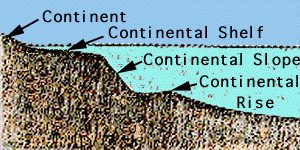
Continental Shelf
- Continuation of
the continent under water
- Slopes gently
seaward
- Generally less
than 130 meters deep
and 65 miles wide on average
|
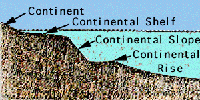 |
Continental Slope
- The break between
the continent and the ocean basin
- A 4 to 5 degree
slope that marks the seaward extent of a continent
|
|
Continental Rise
- A ridge of sediment
parallel to the continental shelf and seaward of the continental
slope
- Rises are found
only along passive continental margins such as the east coast
of the United States
|
|
Abyssal Plains
- Broad, relatively
flat areas of sea floor
- At depths of from
4,000 to over 5,000 meters
- Located adjacent
to passive continental margins
- Located around the edges of
most oceans
|
|
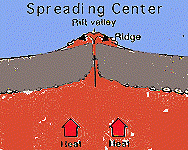
Ridges
- Mountainous systems
with many volcanoes that extend for thousands of miles
- Often in mid-ocean
but some are near continents
- Associated with
divergent plate boundaries (spreading centers)
- Mountains closest
to the spreading center where they are created by volcanism are
the tallest and those further away have cooled, shrunk, and sunk.
|
|
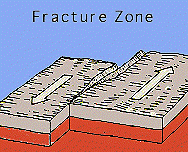
Fracture Zones
- Large cracks in
the sea floor that may extend for thousands of miles
- Associated with
ridge systems running perpendicular to the ridge
- Also associated
with shearing (transform) plate boundaries
- May offset continental
margins
|


|
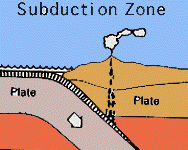
Trenches
- Long, very deep
depressions in the sea floor formed by subduction (movement of
one crustal plate under another)
- There are 31 trenches
with bottoms lying from 4.5 to 6 miles below the ocean surface
- Associated with
convergent plate boundaries (subduction zones)
|

|
Seamounts
- Mountains that
rise from the basin floor reaching heights of thousands of meters
- They often occur
in groups or chains
- They may break
the ocean surface to form islands
- Associated with
plate boundaries or hot spots
|
|
|
|
|
|
|
|
|