
One show is the riotously antic, articulate show of paintings by Monica Aissa Martinez. This colorful, well-designed art seems to cavort through paper and canvas, with two humanoid abstractions (of assorted and combined cocktail glasses, beakers, squiggly lines) showing the convolutions of humans' pairing-game. While whimsical, Martinez's show is beautifully designed and painted, with a message built in - partnering may look hilarious, but it has serious, even threatening dimensions.
Monica Aissa Martinez's calling as an artist was enhanced by her background; she was a member of a creative family and, as she has recalled, "was surrounded all my life by artisans, actresses, writers, musicians, and teachers." Her parents encouraged her creative pursuits and taught her about her cultural background. Even so, Martinez felt a sense of isolation and separateness as a child. Others explained this to her as being a result of her minority status, and, as a Hispanic living in El Paso, she initially regarded it as a condition of her displaced Hispanic heritage. Because her minority status was compounded by being a woman, she also understood it as a woman's issue. Ultimately she came to believe that her feeling of separateness was actually a more universal condition: "I am not sure it is specifically a minority issue; I think it is a human issue." This led her to the belief that the human race is bonded in spirit, a theme expressed in much of her art. Martinez places great emphasis on the importance of education in her career: "I have been influenced by numerous teachers and by the process of teaching itself." She earned her B.F.A. at the University of Texas, El Paso, in 1986 and her M.F.A. at New Mexico State University, Las Cruces, in 1991.
Martinez, who recently had her first solo show at the Scottsdale Museum of Contemporary Art, also is fascinated by the idea of the cup because she sees the human form as being a type of vessel. Her work in the show-My Cup Runneth Over and Source- are painted with egg tempera and casein, on paper, and deal with these same issues.
"I am always thinking about people as containers and how the anatomy works that way,"Martinez says. "And I'm also influenced by this idea of electricity and physics and how it relates to the energy found in human beings."
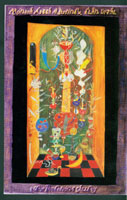
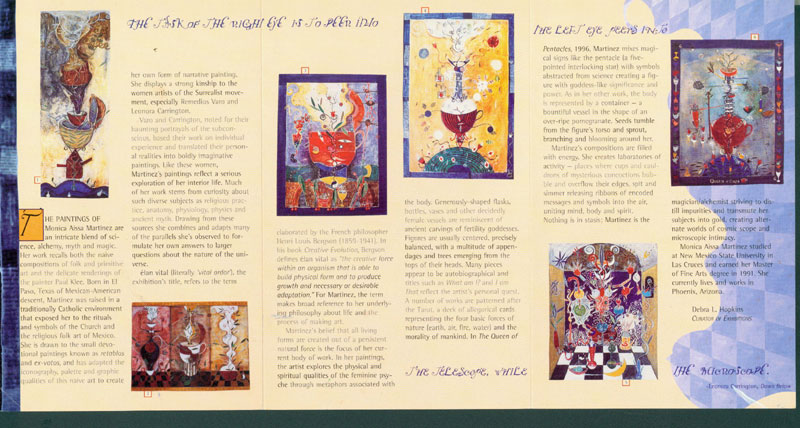
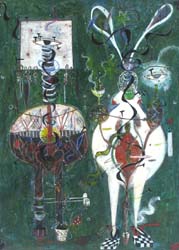
The human body is also the primary subject of Monica Aissa Martinez' small painting. She portrays our bodies as fantastic little factories, maybe tiny sex breweries, in a series of works about brides and grooms. Her blend of dream and science harks back to the early work of Mark Rothko (Slow Swirl on the Edge of the Sea, 1944) or Arshile Gorky's surrealistic series of paintings about human desire and fate (The Betrothal, l and The Betrothal, ll, both from 1947). The humor and small scale of her art make it more about celebration and less about the pain we see in Rothko and Gorky. Martinez says the experience of her recent marriage prompted her to explore the topic of who and what we are in a male/female union. Fascinated by the look of scientific detail in botanical and biological drawings, Martinez treats the figure to a revamping that includes ribbons and champagne glasses. The bodies take on the form of laboratory glasswork. The details in her work hold our attention long enough for us to realize the sly humor of lifting the lid off the marital sacrament to reveal the delightfully intricate plumbing that makes the whole process pump.
all material copyrighted©2005 monica aissa martinez